

Medical breakthrough: Unborn baby treated for genetic condition – Aleteia
Shutterstock | SciePro
Lenten Campaign 2025
This content is free of charge, as are all our articles.
Support us with a donation that is tax-deductible and enable us to continue to reach millions of readers.
A recent case study in The New England Journal of Medicine describes a medical breakthrough in which a group of US doctors treated an unborn baby with a rare genetic condition while still in utero. The unborn child had tested positive for type 1 spinal muscular atrophy (SMA), a rapidly progressing disease that severely weakens the muscles, making it impossible to move or breathe. Children with this condition have historically died by their second birthday.
The pregnant woman in the case study had lost her first child to the terrible disease and was willing to work with doctors in an experiment in which she received the drug Risdiplam every day for six weeks before giving birth.
Risdiplam works by increasing the concentration of a crucial protein called survival motor neuron (SMN) protein in order to prevent the break down of nerve cells in the brain and body; such proteins are lacking in those with the genetic mutations that cause SMA. The drug had previously only been approved by the FDA to treat infants ages 2 months and older. The FDA made a special, one-time exception for this case study.
During the six weeks that the expectant mother took the medication, testing found that the medicine passed through her umbilical cord and into the amniotic fluid surrounding her baby.
After birth, the infant continued to receive the oral medication daily, and the regimen has proven successful thus far. Pediatric neurologist Michelle Farrar, a high-profile SMA researcher in Australia, told Smriti Mallapaty at Nature that the baby girl “has been effectively treated, with no manifestations of the condition” even 30 months after birth.
Aleteia reached out to Kelly Mantoan, the Catholic author of Better Than OK: Finding Joy as a Special-Needs Parent. Mantoan is a mother of five; two of her children have SMA and they take Risdiplam, which has slowed the progression of their disease. She is also the founder of Accepting the Gift, a Ministry for Catholic Special Needs Parents.
Here’s what she had to say about this amazing medical breakthrough:
“When my sons were diagnosed with SMA, there were no FDA approved treatments. But today there are three, including Risdiplam. SMA is no longer presented to parents as a death sentence but a condition that can be treated, saving the lives of countless unborn children with SMA and improving the quality of life for children and adults with the condition. It feels like the miracle mothers like myself prayed for for years.”
To read more about this remarkable medical achievement, check out The New England Journal of Medicine.
Get Aleteia delivered to your inbox. It’s free!
Articles like these are sponsored free for every Catholic through the support of generous readers just like you. Please make a tax-deductible donation today!
Help us continue to bring the Gospel to people everywhere through uplifting Catholic news, stories, spirituality, and more.
Get Aleteia delivered to your inbox. It’s free!
What Parents Should Consider When Choosing Swim Lessons for Kids – Baby Chick
One mom shares how she found the right swim coach for her daughter and explains what to look for when choosing swimming lessons for your child.
by Jessica Tzikas
We all know that swim lessons are vital for children’s safety. The countless stories of tragedies occurring during fun summer days at the pool or on the lake are heartbreaking. But most often, they are preventable.1 As a Florida mom, swim lessons are even more important because my kids are swimming in pools or the ocean all year round. I figured that getting swimming lessons would be easy, and within a few weeks, my little one would be swimming like a fish. Unfortunately, this was not our story — but not for lack of trying. Here, I’ll share my experience with finding the right swimming lessons for my daughter and offer tips on what to look for when choosing them for your own child.
When my oldest turned 2, I started doing research to get her into swimming lessons. I scoured mom groups and signed her up with a highly recommended swim teacher in the area. Friends of mine raved about this swim company, as well as countless strangers who vouched for their expertise. “My kid was diving into the deep end by the first week!” said one mom. “We used them, and all three of mine are now Olympic swimmers!” Okay, maybe not the last one, but you get the point. So, what could go wrong? I set up our first lesson and sighed a breath of relief, knowing my kid would be swimming safely in no time.
We had our first lesson, and she loved it! Things were great — until lesson two. Suddenly, my daughter was shrieking in the pool and terrified of getting in. It was disheartening to watch my water-loving little girl become so scared of the pool. But with the high accolades, I kept going. That is, until my daughter got so worked up that she puked all over the pool. This was my final straw and a hard realization that maybe this wasn’t the right choice for her.
Fast forward a year and three more failed swim teachers later, and finally, we found our match. Coach Chris was recommended to me by just one friend, not an entire mom group. But it was immediately clear that he was the right choice. After one lesson, my daughter never cried in the pool again. In fact, she begged to go to swim lessons and see Coach Chris. Now, after almost a year with him, she’s swimming laps and learning strokes with dreams of being on the swim team when she’s older.
All this to say — choosing the right swim teacher and swim lesson format isn’t as easy as logging into your local Facebook mom group. It may take some trial and error to find a teacher who fits. But to avoid my struggle, there are some things you may want to consider before choosing a swim teacher for your child.
Did you know there are different types of swim lessons you can choose from? There’s ISR (Infant Swimming Resource Lessons), which is for young children and made to teach your baby how to survive in the water. This is a type of lesson in which you may see a child learning to jump in fully clothed and roll onto their back. It’s geared toward survival in the pool and is for younger infants and toddlers — specifically children ages 6 months to 6 years old.2,3,5
Then, there are the more traditional swimming lessons, which is what I opted for with my children. While these lessons also focus on safety (especially with younger children), they do this by teaching swimming fundamentals, like breathing techniques and kicks.3 Both types of lessons can be great options, and choosing the right one is often based on personal preference. (However, it’s worth noting that some parents are concerned about the potentially traumatic effects of ISR, though this criticism seems to be based on anecdotal evidence.6)
Whether you choose ISR or traditional lessons, the most important thing is finding the right teacher. All our kids are different, and in the same way that they all learn differently in school, they also learn differently in the pool. Our first swim teacher was a bit rough, which is great for kids who may need some toughness to be safe in the pool. But that toughness made my highly sensitive child wither in fear and had the opposite effect. Our current coach takes a much more gentle approach. He meets my daughter where she’s at and turns swim safety into fun.
To avoid the struggle we went through, consider chatting with potential swim instructors on the phone. You could even ask to attend another child’s lesson or do a trial class. This will give you a better idea of their teaching style and let you see how they run their class. Pay attention to how they speak to your child — are they more stern or laid back? Do they incorporate water toys and kickboards or teach without props? None of these options are right or wrong, but they can influence how your child learns. Some instructors also teach in groups, and some only do one-on-one lessons. Many children thrive having their peers beside them. Others may be too distracted when other kids are in the pool. Knowing how your child learns, and seeing it firsthand, will help you make the right decision.
Beyond personal preferences, there are some things that all parents should be sure of before signing their child up with a specific teacher, coach, or swim school. The biggest, of course, is their safety practices. Some non-negotiable questions to consider are:4
Regardless of the swim teacher you choose, putting your child in swim classes is a major accomplishment in itself. While it wasn’t as easy as I thought it would be to find the right teacher, knowing my daughter feels safe and confident in the water is worth all the challenges we went through. Now, I just need someone to teach me the best way to get her out of the pool when it’s time to go home!
We base our content on research from peer-reviewed journals, government and advocacy organizations, and academic sources. Learn more about our standards in our editorial policy.
1. Denny SA, Quan L, Gilchrist J, McCallin T, Shenoi R, Yusuf S, Weiss J, Hoffman B; COUNCIL ON INJURY, VIOLENCE, AND POISON PREVENTION. Prevention of Drowning. Pediatrics. 2021 Aug;148(2):e2021052227. doi: 10.1542/peds.2021-052227. Epub 2021 Jul 12. PMID: 34253571.
2. https://www.stepintoswim.org/
3. https://www.bearpaddle.com/
4. https://www.watersafetyusa.org/
5. https://www.isrswimbabies.com/
6. https://www.sunsationalswimschool.com/
Baby Chick provides general information for educational and informational purposes only. The content on this site is not intended to be a substitute for professional medical advice, diagnosis, or treatment. Always seek the advice of your physician or other qualified healthcare provider with any questions you may have regarding a medical condition. Your use of this site indicates your agreement to be bound by our Terms of Use.
© 2015-2025 BABY CHICK, LLC. ALL RIGHTS RESERVED.
Get must-read articles, expert advice, trending topics, product recommendations, exclusive deals, freebies, and more—delivered straight to your inbox! We’ve got you, mama, through pregnancy, birth, postpartum, parenting, and motherhood!
Kids toys not exempt from AI technology at this year's Toy Fair – KTVN
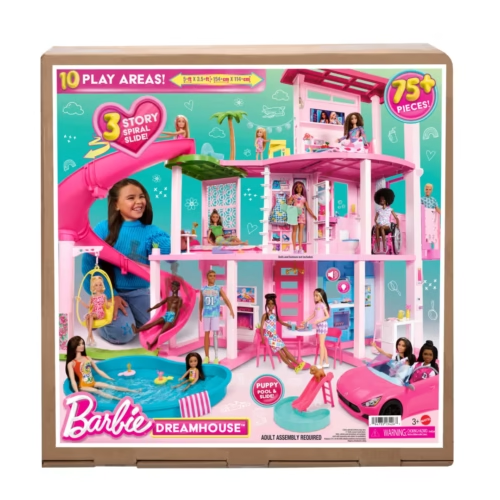
The International Toy Fair took place in New York this week.
Currently in Reno
Your browser is out of date and potentially vulnerable to security risks.
We recommend switching to one of the following browsers:
Get up-to-the-minute news sent straight to your device.
Screen time for kids: How much is too much in 2025? – Motherly Inc.
Home / Child / Child Learn & Play
Photo Credit: Canva/Motherly
The 2025 Common Sense Media Report highlights just how integral screens have become in young children’s daily lives.
Updated Mar. 05, 2025
Table of Contents
As a mom of five, I know firsthand how screen time can slowly take over. What started in our house as a firm “no screens for toddlers” has, 12 years later, become something we constantly negotiate. At different times, I’ve had to reset rules hard—like banning screens during the school week and capping weekend time at two hours. Other days, like when I’m sick, those rules go right out the window.
That’s why it’s so important to frequently check in on the latest research, like the 2025 Common Sense Media Census, which offers a fresh look at how kids under 8 are using screens.
The 2025 Common Sense Media Report highlights just how integral screens have become in young children’s daily lives.
For babies and toddlers, screen use is already significant. Children under 2 spend an average of 1 hour and 3 minutes on screens daily. That number jumps to over 2 hours (2:08) for kids ages 2-4 and reaches 3 hours and 28 minutes for kids ages 5-8.
Related: Former teacher shares her ‘secret weapon’ on reducing screen time
The way kids engage with screens has also evolved. According to the report:
Related: Dr. Becky’s tips for setting screen time boundaries during the holidays are a lifesaver
Let’s be honest—screens have become an essential support tool for many parents. We live in a society that is facing an epidemic of parental burnout. Parents today are stretched thin by:
Given all this, it makes sense that screens have become the stand-in babysitter that parents don’t actually have. And instead of guilt, we need understanding—for ourselves and for each other.
Related: Worried about your baby’s screen time? 5 strategies to reduce the pull
If you’re feeling like screen time has taken over, here are some small, empowering shifts to help bring it back under control:
Most importantly: give yourself grace. We are the first generation of parents navigating this level of digital exposure, without a roadmap. It’s okay to set limits. It’s okay to change them. And it’s okay to use screens when you need to survive the hard days.
Ultimately, screens are just one aspect of childhood. And while the numbers may be shifting, what hasn’t changed is what our kids need most: love, connection, and parents who are doing their best.
Related: Study shows parents need to ‘practice what they preach’ when it comes to kids’ screen time
This statistic is a gut punch, laying bare the dire reality facing millions of parents…
I have five kids, one husband, two feet, and absolutely no idea how to conquer the misery that is family sock management.
From decoding quirky childhood habits to tackling tough parenting challenges, this year’s most-searched topics reflect the universal and unique moments that make raising kids so special.
The 2025 Common Sense Media Report highlights just how integral screens have…
"We know that when screens are in use—either by a parent or a child—there is less talking, teaching and reading."
Researchers discovered tablets may "contribute to a cycle" of problems with emotional regulation.
Woody, Buzz and the gang are gearing up for a tech-filled challenge—and it’s got me thinking about my own kids’ future.
Parental controls are just one of many features on these phones for kids.
The so-called butter sleep hack reportedly began with U.S. parents before making its way to the UK and New Zealand.
DST is around the corner, and sadly, there are no exemptions for the already-sleep-deprived.
Nex turns your living room into an arcade by transforming movement into gameplay…
New research suggests that babies can “taste” flavors in the womb…
Researchers found that a simple, gradual exposure to peanuts helped children with peanut allergies build tolerance.
77% reported that fine motor skills like holding pencils, using scissors, and writing have become more challenging for young students.
One of the girls begins stimming—a common self-regulating behavior often associated with autism, the other little dancer joins right in.
She reimagined her classroom as a workplace-style setting that gave students more autonomy, responsibility, and accountability.
7. "How can I help…"
While the lesson is aimed at children, the reality is that many of us needed to hear it, too.
Celebrate the Chinese New Year with fun crafts.
Ever wonder how to teach your kids to fight fear, to live brave and overcome hard things?
They're not only fun, they're a vital part of development.
Recently, historian Dr. Esmé James shared what's essentially a 4,000-year-old text message from a teenager to his mother.
To date, there have been seven reports of children accessing the fan blades, resulting in six laceration injuries.
? “Me just realizing the room I was told to pump in has a camera.”
The family bed debate is just one piece of a much larger conversation about how families sleep best—and, more importantly, what research actually says about co-sleeping.
And for 15% of moms, baby-related expenses eat up over half of what they bring in.
“I pay my daughter to take naps. Not the baby, the toddler. And before you judge me, this s**t works.”
Teaching kids the value of a dollar, budgeting, and the work ethic that goes into earning money is one of the greatest gifts we can give them.
High fives? Good touch. Hugs? Good touch. Mouth? Bad touch.
© 2025 Motherly. All Rights Reserved.